
Does Rain Clean Solar Panels? What North County Homeowners Should Know

The short answer
Rain does clean solar panels, but only partly. A good, soaking rain rinses off loose dust, and panels tilted at 15 degrees or more get the most help. But here in North County San Diego it barely rains from June through September, and rain won't reliably remove bird droppings, baked-on grime, or the film left behind by morning dew and drizzle, so most local systems still need regular professional cleaning.

What rain actually does to your solar panels
Rain does help. Researchers at UC San Diego studied 186 home and business solar systems across California and treated any rain over 0.1 inch as a "reset" that brought panels back close to clean. Their results showed that between rains, dust cut panel efficiency by about 0.05% per day on average (Mejia & Kleissl, UC San Diego, Solar Energy, 2013).
So rain helps a little. The catch is how much falls, how hard, and what's actually on your glass. And rain only rinses: it can't tell you whether anything on your roof needs attention.
Why rain usually isn't enough in North County
Our dry season is long
Escondido averages 14.52 inches of rain a year, and most of it (about 84%) falls from November through March. From June through September, the official NOAA normals for Escondido add up to less than half an inch combined. On average, the city gets about one day all summer with a tenth of an inch of rain or more (NOAA NCEI 1991–2020 Climate Normals, Escondido #2 station).
Summer is also when your panels make the most power. The UC San Diego study found that during the 145-day summer dry spell in its study year, panels lost about 7.4% of their efficiency to dust. About a quarter of the sites (26%) lost more than 0.1% per day, roughly double the average, and nearly flat panels (tilted under 5 degrees) collected about five times more soiling than the others (Mejia & Kleissl, 2013).
But power isn't the main reason to clean. Think of it like an oil change for your car: you do it even when the engine seems fine. Rain doesn't inspect anything, and every cleaning we do includes a safety inspection that can catch chewed wiring, loose connections, nests, and visible signs of overheating or burn marks (hot spots) early, the kinds of problems national lab guidance links to arc faults and fire risk (NREL/Sandia PV O&M Best Practices Guide). Clean panels also run cooler: uneven soiling like bird droppings can lead to hot-spot failures (NREL/Sandia guide), dust raises module temperatures (peer-reviewed field study, 2023), and Sandia National Laboratories found a strong link between panel degradation and the heat panels experience (Sandia). Better output is the bonus.
Light rain and marine layer moisture can leave panels dirtier
Many of our rain events are light. The NOAA normals show Escondido averages about 41 days a year with any measurable rain, but only about 9 days with half an inch or more. Add the marine layer that rolls in on spring and early-summer mornings, and panels often get damp without ever getting rinsed.
In our experience, that's when dust turns into streaks and a muddy line along the bottom edge of each panel, right where the water dries. National lab research backs up the idea that rain is unpredictable: an NREL analysis of soiling-station data found no clear rainfall amount that reliably cleans panels, and noted that panels don't always return to fully clean after a rain (NREL, Time Series Analysis of Photovoltaic Soiling Station Data, 2017).
Santa Ana winds, farms, and dry hillsides add dust
In fall and winter, Santa Ana winds can blow dry air and dust in from the east and inland valleys. Homes near groves, nurseries, horse properties, and open land in places like Valley Center, Bonsall, and the edges of Escondido and San Marcos tend to see more dust and pollen.
Rain doesn't remove the sticky stuff
Bird droppings are the big one. They dry hard, stick to the glass, and can shade part of a panel. Pigeons nesting under panels and coastal gulls in Oceanside and Carlsbad are common culprits. Pollen and plant residue can also stick through rain. NREL researchers found that springtime pollen on solar sites in North Carolina, a much rainier place than ours, cut performance by as much as 15% at peak, and rain didn't bring the panels back to their clean levels (NREL News, 2023).
How to tell if rain did the job
A few simple checks:
Compare your production. Open your solar monitoring app and compare a clear, sunny day now with a similar clear day right after a cleaning or a big storm. A steady drop with no change in the weather usually points to dirt.
Look from the ground. Use binoculars or a phone zoom from a safe spot. Look for bird droppings, a dusty haze, or a dirty band along the bottom edge of the panels.
Think about your surroundings. Low-tilt roofs, homes near farms or construction, and homes with lots of birds tend to need more help than rain can give.
Even if your production looks fine, rain can't spot a chewed wire, a loose connection, or a cracked panel. That's why regular cleaning with an inspection is worth scheduling either way.
Please don't climb onto the roof to check. Wet or dusty panels and tile roofs are slippery, and we cover the risks in Is Solar Panel Cleaning Safe?.
When to clean: before or after the rain?
For most North County homes, we recommend two cleanings a year. Let the winter storms do what they can, then schedule a cleaning in late spring, before the long dry summer when your panels produce the most, and a second one in late summer or fall to clear summer dust and Santa Ana debris. Homes with a lot of birds or dust may need more. Our guide on how often to clean solar panels goes into more detail.
One more tip: don't "help" the rain with a garden hose. Tap water in much of San Diego County is hard, and it can leave mineral spots behind when it dries (see our post on hard water stains on solar panels). National lab guidance also stresses taking care not to damage components during cleaning and following the panel maker's recommendations (NREL/Sandia guide).
How we clean panels when rain isn't enough
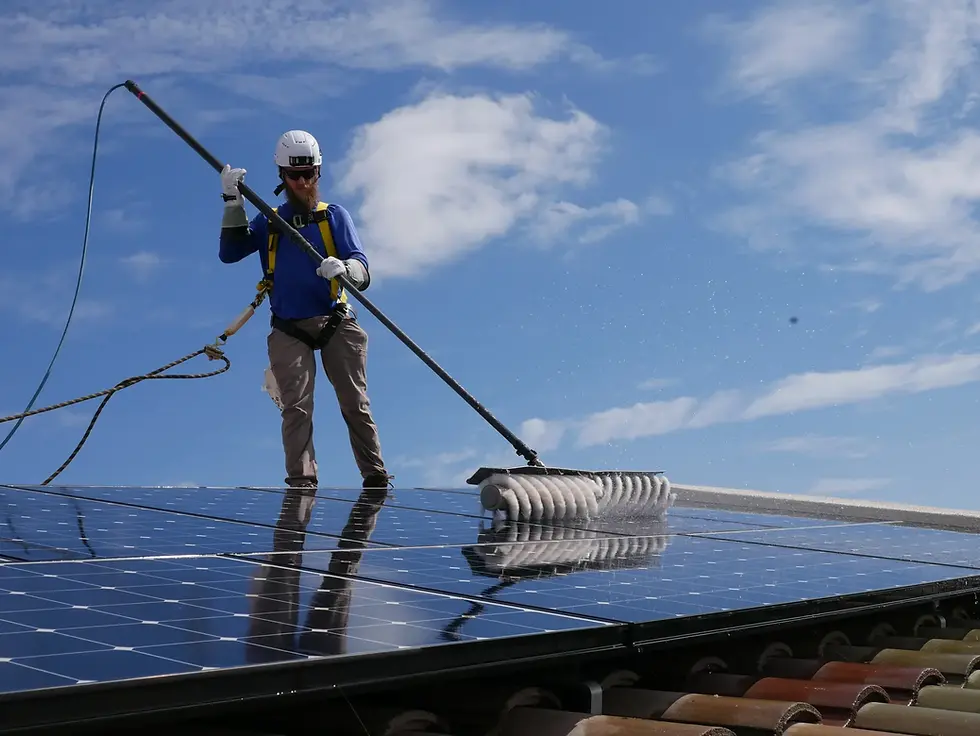
At Nomadic Home Services, we use pure, deionized water and soft brushes. Pure water dries without spots, and soft brushes lift droppings and grime without scratching. Every job is done with fall protection, and every cleaning includes a safety inspection of your system.
Austin is an ISCA Certified (CSPC) solar panel cleaner, and Nomadic Home Services holds ISCA Company Accreditation. We were California's first ISCA-Accredited company. Our team is OSHA 30-Hour trained and has completed ISCA PV Fire Safety Training. In November 2025, we received the Jason Knight Safety Progress Award at the Solar Panel Cleaning Convention. We're also a PWNA Contractor Member.
Frequently asked questions
Does rain clean solar panels in California?Partly. A heavy rain rinses off loose dust, but much of California, including North County San Diego, gets very little rain from late spring through early fall. Panels can collect dust for months during the season when they make the most power.
How much rain does it take to clean solar panels?There's no exact number. A UC San Diego study treated more than 0.1 inch of rain as cleaning the panels, but NREL research found no clear rainfall amount that reliably does the job. Heavier, steady rain on steeper panels does the most good.
Does rain remove bird droppings from solar panels?Usually not. Dried bird droppings stick to the glass and often stay put through light or moderate rain. They should be soaked and gently brushed off with soft tools and clean water, never scraped.
Should I clean my solar panels before or after it rains?After the rainy season is usually best. Let winter storms rinse off what they can, then schedule a cleaning in late spring, before the dry summer months when your panels produce the most, and a second one in late summer or fall.
Can I just hose off my solar panels instead of waiting for rain?We don't recommend it. Hard tap water can leave mineral spots, and getting on the roof is risky. Professional cleaners use purified water, soft brushes, and fall protection.
Ready to schedule your next cleaning?
If it's been a while since your last cleaning, or you can see droppings or dust on your panels, let's get you on the schedule. Every cleaning includes a safety inspection, and residential solar panel cleaning starts at $250.
We serve Escondido, San Marcos, Vista, Carlsbad, Oceanside, Poway, Rancho Bernardo, Valley Center, Bonsall, Rancho Santa Fe, Fairbanks Ranch, and 4S Ranch. We're open daily from 8 AM to 6 PM.
Call (619) 333-6858 or request a free quote online.
Nomadic Home Services · 740 Metcalf St, Suite 8, Escondido, CA 92025


Comments